
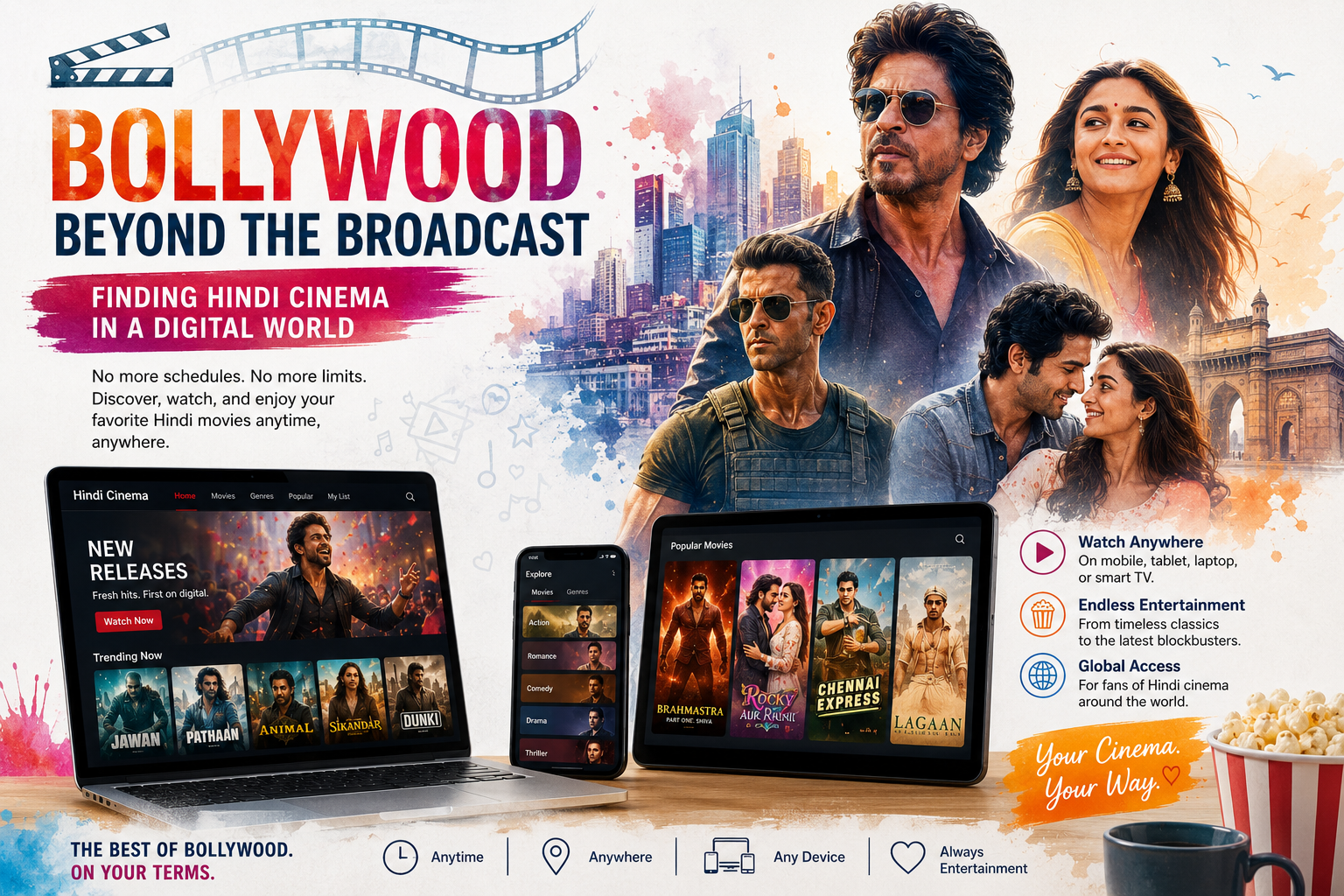
Bollywood has never been limited to a single type of audience or a single way of watching films. Hindi cinema has developed into a vast cultural industry with an international reach, supported by decades of theatrical exhibition, television distribution, music, physical media, and now digital platforms. Its appeal is also broader than the familiar image of large-scale musical entertainment. Contemporary Hindi cinema moves across drama, comedy, romance, action, crime, suspense, family entertainment, fantasy, and other genres, giving online audiences an unusually broad field for discovery. For viewers looking for বলিউড মুভি অনলাইন, the digital catalog provides a more flexible way to explore this constantly evolving part of Indian cinema.
From a National Film Culture to a Global Digital Audience
The international presence of Hindi cinema has been developing for decades, particularly through Indian diaspora communities. What has changed more recently is the ability of digital distribution to introduce Hindi-language films to audiences who have no direct connection to India’s traditional cinema markets. An IMDb report on Indian cinema notes that streaming accessibility is helping more Indian films move beyond domestic and diaspora audiences and reach wider international viewers.
This creates a different kind of relationship between Bollywood and its audience. A viewer no longer needs to live near a cinema that regularly screens Hindi productions or depend on a local television channel carrying Indian entertainment. An online catalog can function as a direct gateway, allowing people to explore Hindi cinema according to personal interests and available time.
For international audiences, this accessibility also makes Bollywood easier to approach as part of a wider global film culture. Hindi-language entertainment can sit alongside productions from other countries, allowing viewers to discover differences in genre, music, visual design, and cultural perspective without treating regional cinema as something distant or difficult to access.
The Many Faces of Contemporary Hindi Cinema
The term Bollywood often creates an immediate visual association with music, dance, romance, and spectacular production design, but the modern Hindi catalog is far more varied. Contemporary Hindi filmmaking covers a broad spectrum of genres and increasingly experiments with different tones, subjects, production methods, and formats.
This diversity is one reason a digital catalog can be more useful than a conventional programming schedule. A viewer interested in crime or suspense does not need to wait for a particular broadcast, while someone looking for comedy, family entertainment, romance, or action can explore those categories independently. The catalog becomes a map of Hindi cinema rather than a single linear stream of programming.
Recent research into Hindi screen culture also points to the way streaming has expanded opportunities for niche themes and alternative production approaches, partly because digital platforms are less dependent on the traditional constraints of theatrical box-office performance and broadcast scheduling.
For viewers, the practical consequence is greater choice. Bollywood can be explored through its familiar mainstream identity while also revealing a wider range of contemporary Hindi-language entertainment.
Why Music Remains Central to Bollywood’s Identity
Music has a particularly important place in the history and cultural influence of Hindi cinema. Bollywood songs have long existed beyond the films themselves, becoming part of India’s broader popular music culture. The relationship between cinema and music is therefore more extensive than simply adding songs to a visual production.
This musical identity has also evolved through interaction with different traditions. Hindi film music has drawn from classical and modern Indian sources as well as influences from Urdu poetry, Punjabi musical culture, and international sounds. That mixture has helped Bollywood soundtracks travel beyond their original cinematic context and reach audiences who may encounter the music before becoming familiar with the films themselves.
For online viewers, high-quality digital playback is therefore significant because cinema is experienced through both image and sound. Clear audio, stable streaming, and an interface that allows viewers to move directly from catalog discovery to playback help preserve the audiovisual character that makes Hindi cinema so recognizable.
A Catalog Designed for Exploration Rather Than Scheduling
Television once determined much of the rhythm of home entertainment. A movie appeared at a scheduled time, and viewers either watched it then or waited for another opportunity. Digital catalogs have reversed that relationship. The audience now decides when exploration begins and when a viewing session takes place.
This change is particularly valuable for Bollywood because the breadth of Hindi cinema can encourage browsing before a decision is made. Viewers may enter the catalog without a specific title in mind, move between genres, notice different shelves, and eventually select something that fits the moment.
A clean interface makes this process considerably more comfortable. Moviewala’s direct catalog-to-playback approach means viewers can select a title from the shelf without being forced through a registration wall first. The absence of annoying pop-ups also keeps the browsing experience focused on cinema rather than distracting promotional elements.
The result is a more natural digital equivalent of browsing through a personal movie collection. The difference is that the collection remains accessible online and can be explored without the physical limitations associated with DVDs or other media.
How Streaming Is Changing Hindi Film Discovery
Digital platforms are not merely changing where Hindi films are watched; they are changing how audiences discover them. In traditional media, visibility was heavily influenced by theatrical promotion, television schedules, newspaper coverage, and physical distribution. Digital environments add search, recommendations, curated shelves, social discovery, and platform-based catalog organization to that process.
Research published in 2026 on Hindi cinema audiences also indicates that digital media is playing an increasingly important role in film discovery and audience engagement. This means that the path toward a movie can begin long before playback, with audiences encountering categories, recommendations, discussions, or other digital signals that influence what they decide to explore.
For a streaming catalog, this makes organization particularly important. A large collection needs to remain understandable. Genre sections, curated shelves, recent additions, and straightforward navigation can help viewers move through the selection without feeling that the number of available choices is itself an obstacle.
The strongest experience keeps discovery fluid. A viewer can browse, open a title, return to the catalog, explore another category, and continue without repeatedly encountering barriers.
Bollywood on the Screen That Fits the Moment
The contemporary Bollywood audience is also increasingly device-independent. Smart televisions remain central to home viewing, but laptops, tablets, and smartphones have become important access points for digital cinema. The screen can change according to location, time, and personal preference without changing the underlying catalog.
This flexibility matters particularly for international viewers. Someone living outside India may not have access to Hindi television programming but can still reach an online catalog through a compatible device. A Bengali-speaking user, an Indian diaspora viewer, or someone simply interested in South Asian cinema can approach the same Hindi-language selection from a very different cultural and geographical context.
The interface therefore needs to remain readable and intuitive across screen sizes. Large television displays should provide an easy browsing experience, while mobile screens require compact navigation and responsive playback controls. The technology works best when these differences are handled quietly.
For the viewer, the ideal interaction remains simple: find a Hindi movie, select it, and begin watching without unnecessary technical steps.
The Technical Layer Behind a Smooth Bollywood Experience
Streaming a high-quality movie is technically demanding. Digital platforms must process large audiovisual files and deliver them efficiently to audiences using different devices and internet connections. Cloud infrastructure, content delivery networks, modern codecs, adaptive bitrate streaming, and efficient data management all contribute to this process.
The importance of these systems becomes particularly clear when audiences are geographically dispersed. A Bollywood catalog can attract viewers across India and international markets, each with different network conditions. Distributed delivery infrastructure helps reduce the distance between content and users, while adaptive playback can respond when bandwidth changes.
Compression technology is equally important. High-resolution cinema contains a large amount of visual information, so efficient encoding helps balance picture quality against data requirements. When these systems work effectively, viewers receive a stable and detailed presentation without needing to understand the engineering behind it.
That invisible quality is an important part of premium usability. The infrastructure should support the movie rather than become another problem the viewer has to solve.
Beyond the Traditional Bollywood Label
The digital era is also making the boundaries around Indian cinema more interesting. Bollywood remains a major international label for Hindi-language popular cinema, but audiences now encounter Hindi productions alongside films from Tamil, Bengali, Telugu, Malayalam, Marathi, and other Indian-language industries.
This broader environment creates more opportunities for comparison and discovery. Hindi cinema can remain a distinctive category while participating in a much larger Indian entertainment ecosystem. Streaming has helped make that ecosystem more visible by allowing audiences to move between languages and regional traditions through digital catalogs.
A 2026 country profile of India’s streaming market describes the environment as highly competitive and strongly shaped by linguistic diversity, with global and domestic platforms increasingly serving Hindi as well as regional-language audiences. This development suggests that the future of Indian digital entertainment will not be defined by one language alone.
For Bollywood, that is not necessarily a limitation. Instead, it creates an opportunity for Hindi cinema to be discovered alongside other Indian traditions while retaining its own recognizable cultural identity.
A More Flexible Future for Hindi Cinema
The future of Bollywood online will likely be shaped by the combination of cultural familiarity and increasingly sophisticated digital access. Faster networks, improved compression, better device compatibility, and smarter catalog organization can make large collections easier to explore without making the interface more complicated.
Streaming has already altered the relationship between Hindi cinema and international audiences. India’s Ministry of Information and Broadcasting has described the OTT sector as an important contributor to the global circulation of Indian stories, creative talent, cultural heritage, and independent filmmaking.
That wider circulation gives Bollywood a new kind of reach. The audience is no longer defined only by geography or television distribution. Viewers can discover Hindi cinema through an online shelf, explore different genres at their own pace, and choose the screen that best suits the moment.
The experience ultimately works best when it remains uncomplicated. Open the Moviewala Bengali-language catalog, explore the Bollywood section, choose a title directly from the shelf, and press play. High-quality playback, direct access, no registration wall, and an uncluttered interface allow the technology to remain in the background while Hindi cinema takes the foreground.